
I used to own far more clothes than this wardrobe should, and still open it every morning wondering what on earth to wear. Then one autumn I spent a long weekend in Copenhagen, and I realized the women on that street were wearing less than I was — and looking twice as put together.
Scandinavian style is rarely the fashion headline; the interiors get all the attention. Clean lines, honest materials, nothing that shouts. But the way the women dress deserves the same respect. From Copenhagen to Stockholm to Oslo, the formula is the same: great basics, practical clothes, and just enough surprise — a strange proportion, an unexpected color, a playful accessory — to keep it from ever looking like homework.

That’s the part that makes it so appealing. Nothing looks overworked. The clothes have to survive real life, and somehow they still look styled. After six years buying other people’s clothes for a living, I can tell you the Nordic approach is the closest thing to a cheat code I’ve found. So let’s turn it into a plan. Thirteen moves, and the capsule I’d build around them.
Where to look for inspiration
The easiest route is straight to the source. Brands like Arket, COS, & Other Stories, GANNI, FILIPPA K, By Malene Birger, Stine Goya, Toteme, H&M, Acne Studios and Cecilie Bahnsen all do this look well, and there’s no rule saying you have to buy from them. I treat their lookbooks like free styling classes — I study how they handle proportions, layering and color combinations, then recreate the ideas with what’s already in my closet. That’s where the real savings are.
1. Start with really good basics
A crisp shirt, beautifully cut trousers, a great pair of jeans, a simple sweater, a well-made coat. Boring, on paper. But these are the workhorses, and the workhorses are the whole game.
Instead of filling the closet with complicated pieces, upgrade the five or six things you actually wear. Good fabric, a cut that flatters you, one detail that makes a plain piece interesting. My white shirt, for instance, has an oversized shape and asymmetric hem — it’s still just a white shirt. A sweater with exaggerated sleeves or a beautiful texture counts as effort, even when it’s just a sweater. Simple doesn’t have to mean basic.

As seen in the basics: COS cotton crew-neck tee, H&M gathered-sleeve jacket, COS pleated wide-leg pants, H&M wide-leg jeans.
2. Play with proportions
One of the fastest ways to borrow a Nordic feel is to get a little loose. Oversized shirts, relaxed blazers, longer coats, generous knits — worn with wide-leg or barrel-leg pants. The silhouette becomes part of the outfit, not just the clothing.
The trick is making volume look intentional. I pair a roomy sweater with sleek trousers, an oversized shirt with straight-leg jeans, a long coat over a deliberately simple outfit. If both top and bottom are voluminous, I show the wrists or the ankles, or add something structured — a defined bag, a clean shoe — to pull the line back down.

The outerwear row above: COS double-faced wool-blend scarf jacket, COS fluid mock-neck blouse, pleated wool-blend culottes.
3. Build on a neutral base
If the quieter side of this style is what pulls at you, start with black, white, cream, gray, navy, camel and chocolate brown. It makes mixing and matching almost automatic, and it’s the palette behind that understated Nordic look.
But don’t make everything match perfectly — that’s how a neutral outfit goes flat. I mix tones and textures on purpose: cream knitwear with white jeans and a camel coat, charcoal gray with black and a silver earring. The variety in the fabrics is what keeps the quiet palette alive.
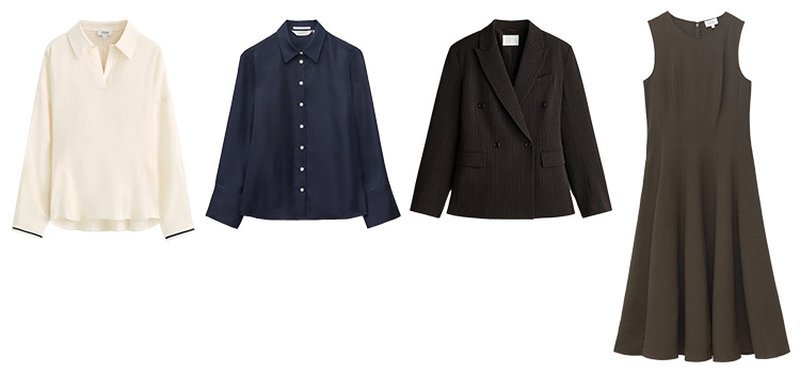
A neutral mixing row: & Other Stories relaxed silk shirt, COS contrast-tipped sculpted open-collar shirt, H&M double-breasted blazer, & Other Stories vertical cutline midi dress.
4. Make knitwear a proper investment
Scandinavian winters are what they are, so knitwear isn’t an afterthought there — it’s the backbone of the wardrobe, and it should be yours too.
Go past the basic crewneck: chunky textures, oversized cardigans, polo-necks, patterned knits, interesting sleeves. And don’t relegate them to jeans. I wear knitwear over dresses, with tailored trousers, with satin skirts — that’s the practical-meets-polished combination the whole aesthetic runs on. A beautiful sweater is one of the best cost-per-wear decisions you can make, full stop.
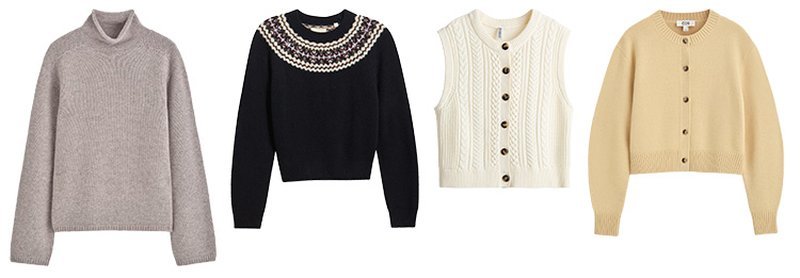
Knitwear worth the shelf space: COS cashmere mock-neck sweater, DÔEN cashmere sweater, H&M cable-knit sweater vest, COS merino wool sweater.
5. Don’t be afraid of color
Here’s where the modern Scandinavian wardrobe gets interesting, because the minimal-neutral reputation is only half the story. The streets of Copenhagen Fashion Week regularly tell a much brighter one: red, cobalt blue, green, pink, yellow — all sitting happily next to the quiet staples.
The easiest version for a busy week: one unexpected color. Pick your favorite and let it carry the outfit — a bright sweater with neutral trousers, colorful shoes with jeans and a blazer, a bold bag on an otherwise understated look. Feeling bolder? Try an unusual combination instead: pink with red, blue with brown, green with burgundy. A simple outfit gets a lot of personality from that alone.

Color done the Nordic way: H&M knit sweater, H&M sneaker, The Sak leather satchel, Nordstrom cashmere scarf.
6. Find your one great coat
Outerwear matters enormously in Scandinavian dressing. When your coat will be visible for most of the year, it becomes part of the outfit rather than something you throw over it. I’ve learned this the hard way — my old coat was doing the work of three new ones, and it showed.
A long wool coat is the ultimate version of this. A relaxed cut in camel, gray, navy, chocolate or black, and you’ll wear it for years. If that’s not your shape, oversized trenches, practical parkas, quilted jackets, leather or suede, barn jackets — all in the family. Don’t be shy of volume: a generously cut coat layered over knitwear looks wonderfully sophisticated.
7. Make comfortable shoes part of the outfit
Scandinavian style has a great argument for the rest of us: comfortable shoes don’t have to spoil a polished outfit. Sneakers, loafers, ballet flats, flat boots, chunky boots, practical sandals — all of it works.
Instead of reaching for heels to make an outfit look smarter, I pair relaxed footwear with the polished pieces: sneakers with tailored trousers and a coat, loafers with jeans and an oversized blazer, chunky boots with a feminine dress. The contrast is what makes it feel current.
8. Mix masculine and feminine
There’s a quiet contrast in most Scandinavian outfits that keeps them from feeling costume-y. A romantic skirt with a chunky sweater. A feminine dress under an oversized blazer. Tailored trousers softened with a silk blouse or ballet flats.
My rule: if an outfit reads too sweet, add something structured or a little masculine. If it reads too severe, bring back softness through fabric, color or an accessory. That tension is what makes a simple combination interesting to look at.
9. Embrace denim
Denim fits the practical side of this style perfectly. Straight-leg, wide-leg and relaxed jeans are the workhorses, but denim shirts, skirts and jackets belong in the wardrobe too.
The move I’d actually try this week: stop defaulting to a t-shirt and pair your jeans with a beautiful knit, an oversized blazer, a long coat, or interesting shoes. Double denim works as well — keep the washes close together for a streamlined line, then add a leather bag or a contrasting knit.
10. Add pattern on purpose
Stripes are the obvious starting point, especially on knitwear and shirts. Checks, geometric prints, florals and graphics can work too — you just don’t need several of them in one outfit.
Patterned trousers with a plain sweater. A striped shirt under a neutral jacket. A printed dress grounded with flat boots and quiet accessories. The pattern becomes the focal point, and everything around it stays simple enough to let it do the talking.
11. Prioritize natural fabrics and texture
Part of why this style photographs so well is that the clothes look good to touch. Wool, cashmere, cotton, linen, leather, suede, denim — texture arrives without a single embellishment.
This matters more than people think if your wardrobe leans neutral. A cream outfit mixing wool, silk, leather and denim has far more depth than one where every piece has the same finish. When I’m shopping, I hold the fabric up and ask how it contributes to the outfit — not just whether I like the color and the shape.
12. Choose accessories with personality
These outfits look effortless, but the accessories are doing more work than they let on. An unusual bag shape, a colorful scarf, chunky earrings, a statement necklace, an interesting pair of glasses — any one of these can completely change a combination of jeans, a sweater and a coat.
My approach is the opposite of more: one or two pieces that make an impact, not a full set. And nothing has to match. A bright bag or an unexpected shoe color is often exactly what gives an understated outfit its personality.
13. Leave a little room for imperfection
The most useful lesson in all of this: don’t make everything too perfect. Roll up the sleeves. Half-tuck the shirt. Wear the sneakers with the tailored trousers. Let an oversized coat stay oversized instead of belting it into submission.
If every element is perfectly coordinated, the outfit loses the relaxed quality that makes the style work in the first place. Put together, yes — but not constructed. Exactly the difference between looking dressed and looking like you were dressed.
My Scandinavian capsule, piece by piece
So what actually goes into a Scandinavian-inspired capsule? I keep it close to the 30 pieces I’ve worn for years, and the core looks like this:
- The base: a great pair of jeans, wide-leg trousers, a crisp shirt, a simple t-shirt.
- The layers: a beautiful sweater, an oversized blazer, a long coat.
- The softer side: a midi skirt or a relaxed dress.
- The shoes: sleek sneakers, loafers, practical boots.
- The finish: a structured leather bag, an interesting scarf, a few pieces of contemporary jewelry.
Keep the whole thing within one cohesive palette so everything combines, then let a little color, pattern or one unexpected accessory do the talking. The goal is not to copy a Copenhagen outfit head to toe — it’s to borrow the ideas that make Scandinavian fashion so appealing: great clothes, interesting proportions, practical footwear, and just enough personality to make it all feel like yours.
Try this one swap this week: take the most basic outfit in your closet — the jeans, the plain top, the coat — and change exactly one thing on it. A roomier knit, a brighter shoe, a structured bag. That’s the whole method in a single move.
Wear it well — Elise